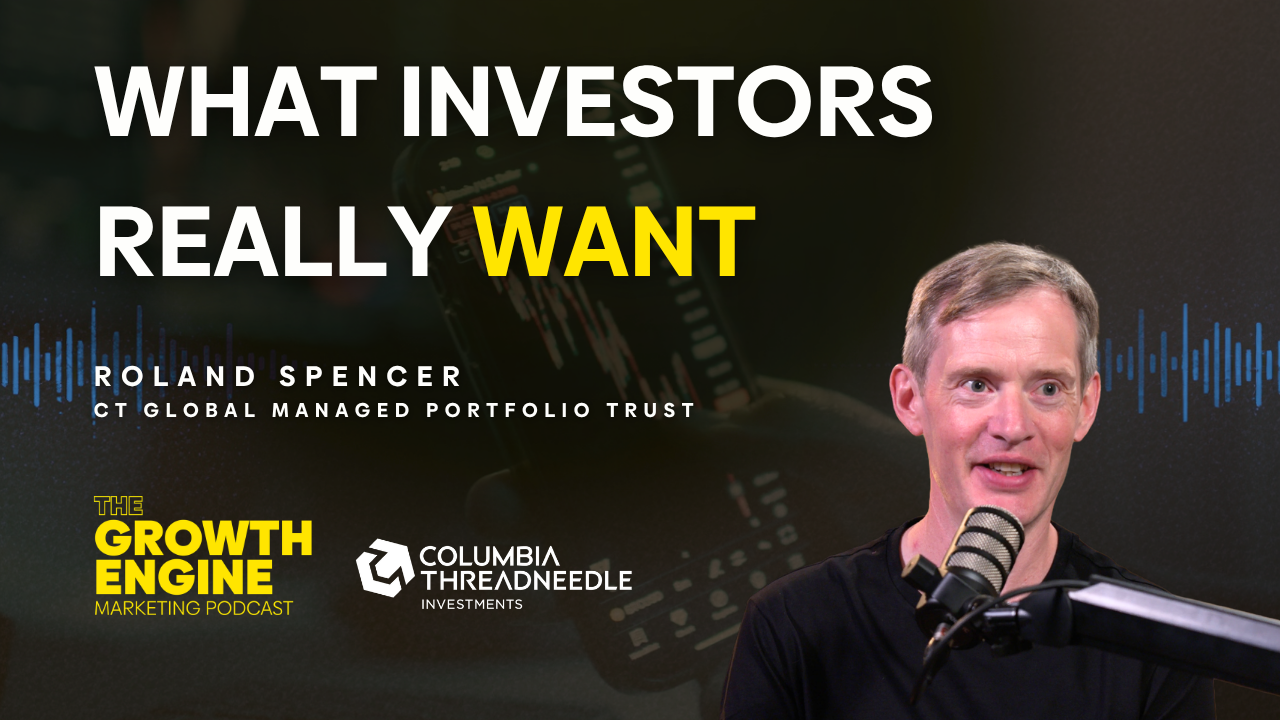
Episode 1 Key Takeaways:
Ross is Head of EMEA Marketing and Direct to Consumer, and Co-Head of Digital Distribution at Columbia Threadneedle Investments, the asset manager behind F&C Investment Trust. With 25 years across financial services, fintech, and consumer brands, he’s led marketing transformation from start-ups to FTSE 100 businesses. Ross is the architect of FNC’s multi-award-winning rebrand, taking the world’s oldest investment trust from a heritage story to TikTok-native retail investor brand.
Social media, without a doubt, is not going anywhere at the moment. There’s today’s audience, and there’s tomorrow’s audience. If we want to target these customers and get them investing, this is how we need to do it, and this is why. It was a big, bold move.
Wow. TikTok and social media as a whole are increasingly important. There’s no getting away from that, so we need to make sure we’re doing it in a way that’s going to resonate with those audiences.
Today, I’m really keen to talk about the FNC story because, as you know, we’ve done a documentary series on investment trusts, and FNC is often talked about. Not only is it the oldest investment trust, but it’s also arguably one of the best in its field in terms of marketing, and that’s the story I want to unpack today.
So let’s dive straight in. Can you give us an overview of the FNC transformation? Why has it been such a defining campaign?
Keen to hear the story from… specifically about the investment trust. As you said, it’s the world’s oldest investment trust, and it really did revolutionize how people invested. It was designed back in 1868, launched with the purpose of enabling what was then called the investor of moderate means. We now refer to that as the everyday investor.
Right. It’s just a slightly more modern approach, but the sentiment is the same. Exactly. And in 2018, the trust was celebrating its 150-year anniversary. The chair at the time gave us a very simple brief: the trust has been around for 150 years. Use this opportunity to make sure it’s positioned to sustain well for the next 150 years. Pretty concise, quite bold, a little daunting, but also very exciting. That’s a fantastic brief from a marketing perspective. We really used the opportunity to take a proper step back. The board has been fantastic throughout — always challenging in a good way, pushing us, supporting us, and questioning our innovation: “We say we’re innovative; prove it.” I love that type of challenge. So we pulled together for the 150-year celebration. We focused on being innovative, but fundamentally, it was about making sure FNC is well known for what it does. There aren’t many trusts that can say they’re the oldest in the world, sustained over such a long period, and still deliver a fantastic product. When I first started, I remember the trust had brought on a marketing specialist not from the industry — interestingly, they had strong credentials in travel. It worked really well together in terms of getting recognition, understanding the proposition, and defining the audience — and importantly, who isn’t the audience. That’s something I always emphasize: trying to be all things to all people ends up meaning you’re nothing to anyone. Right. Throughout my career — for example, Saga over 50s is very clear on who the audience is and who it isn’t. For FNC, in the years leading up to 2018, we focused on fundamentals: understanding the market, getting foundations in place. 2018 was about solidifying the trust. Then we moved forward, probably around 2020, after the 150-year celebration, to take the next step in the journey. Roy, I’m keen to rewind a bit to the strategic foundations. Can you give us more detail about what went into those, particularly around identifying the right audience? Yes. Marketing requires understanding the market, the audience, and the product. But it should be possible to articulate all of that simply, ideally on one sheet of paper, showing how it fits together. That’s the beauty of it. Many businesses can’t do that because things aren’t aligned. So we looked at audiences: institutional investors, intermediaries, retail investors. What type of retail investors? What do they look like? What concerns might they have? What’s their thought process? Opinions vary, so we kept it objective. We looked at the market, buying behavior, and trends over the last 10–15 years. One thing that stands true is simplicity and trust — not surprising, as this applies across many products, not just investments. We’re talking specifically about retail investors here. Yes. Retail investors are a key part of FNC’s audience. How would you describe FNC’s typical client? The everyday investor. That simplicity is important. We conduct research annually, and sometimes deep dive into specific areas. I also put myself in the customer’s shoes — would my mom invest in this? Would my friends? It’s not statistically valid, but combined with research, it helps understand the customer’s mindset. FNC looks visually distinct compared to peers. Presumably, that was deliberate. Can you talk about the thinking behind that? Every element of FNC’s campaigns is thoughtfully designed. The “POP Pink” is probably what you’re referring to. Right. In 2018, the trust rebranded from Foreign & Colonial to FNC. Around 2020–2021, we introduced the POP Pink, creating a more distinctive look and feel. That wasn’t accidental — it considered the audience today and tomorrow. The trust has been around for 150+ years, and we needed something fresh and engaging to stand out, appealing to investors who aren’t necessarily highly engaged in finance. That distinctive asset was part of ensuring FNC resonates. It’s about standing out for the right reasons. In financial services, there are few colors in that space, so using POP Pink creates distinctiveness appropriately. Yes. It reminds me a little of the conscious decision Monzo made with their orange card — really distinctive and ownable. Exactly. Almost a badge of honor. When POP Pink launched, the board was bold and supportive, pushing the initiative forward. The board’s role is to challenge but also support — ensuring marketing decisions are bold but aligned with shareholder interests. Having a talented marketing specialist on board helps translate marketing language for the board and maintain alignment. Many people gravitate toward tactics because it’s fun — creating ads or campaigns. But strategy requires objectivity: understanding the market, customers, and aligning creativity with objectives. Tactics have more subjectivity, but they must be checked against strategy. Ensuring alignment with the board and marketing representatives is crucial to achieve objectives. Some of the visible marketing outputs include the TV campaign, where POP Pink was brought to life, and more recently, FNC’s TikTok channel. Many companies jump straight into tactics without traction. Why do you think FNC has succeeded? TV first — around 2020 — to amplify the message to retail investors. We were clear on audience, message, and strategy. TV generates trust, reaches large numbers, and can be targeted. Out-of-home advertising was also used — bold moves for a business like ours, with measurable impact. Social media, particularly TikTok, was obvious for today’s investors and essential for tomorrow’s. TikTok is our flagship format, driving huge engagement: views, likes, shares. Who appears on TikTok? We use influencers, in-house individuals, and others. The key is relevance and engagement: explaining things clearly and engagingly, serving marketing objectives while helping customers understand and engage. Content production is regular and consistent. And how regular is “regular”? Weekly? Yeah. At least. Yeah, we do a lot, and it is resonating really well. And then we also do it platform-native. What you do on TikTok is going to be different from how you might do it on Instagram or Facebook, for example. We’re specific on that. We’ve been very deliberate. One thing I’ve often heard marketing teams within asset management houses talk about, when it comes to social for communications, is the need to balance reactive content pushed out regularly with compliance signing off on posts. How do you manage that, FSD? I think if you take a real step back, what does the regulator want you to do? They want you to provide financial products that are relevant to the audience in an appropriate manner — no mis-selling. A lot of businesses don’t necessarily look at it from that perspective; it becomes tick-box: “This is how we have to do it.” Don’t get me wrong, there’s an element of sentiment that’s appropriate. My team has worked closely with compliance from the start. That’s really important. The compliance team have been brilliant, trying to understand the media and what we’re doing. They’ll ask, “I get it, but what about this?” Then we come back with ways to make it work in a compliant manner. Not unreasonable ways. That takes a huge amount of effort. If you really understand the audience and what the regulator is trying to do — consumer duty — then you can work with it from the customer perspective. More often than not, you can come up with a solution that works for everyone. It’s been about working closely with compliance as a genuine partner, and we’ve been fortunate to have an extremely good compliance team. One of the outputs we were looking at literally fifteen minutes before you came was a video with a high volume of views and engagement explaining the term “capital at risk.” I would have thought most teens would say, “Hey, we’re going to make a video explaining capital at risk?” Everyone would previously have thought that was going bonkers. But you’re proving that’s not the case. There is an audience that is interested. From a consumer duty perspective, I’d imagine regulators would be pleased. Exactly. If you take a step back and think about what the regulator is trying to do — understanding. There are many ways to do that, and social media isn’t going anywhere anytime soon. It will increasingly become more mature, more key for audiences, and more important for businesses. If you understand the audience and their questions, you can explain it in a way that resonates on the platform you’re using. Keeping it native to the platform is critical. This is a great example of aligning with consumer duty principles. When it comes to identifying key objectives in your marketing strategy, how do you prove it’s working? It’s about being very clear and deliberate about specific objectives. From awareness to consideration to conversion to sales and retention — for most businesses, sales or flows are the ultimate objective. That’s the key point. If nobody’s aware of you, they can’t consider or convert. Right? And if everyone’s aware but no one’s investing, that’s also not good. It’s about how something fits into the overall customer journey. What job does it need to do at that point? You could have a business focused only on awareness. If flows aren’t coming through, it’s hard to show it’s working. We often take a two-speed approach. Today, we talk to individuals already in-market, raising awareness and encouraging conversion. Equally, we nurture tomorrow’s audience. That balance feels like a sensible mix. Predominantly awareness-focused activities may not show immediate flows but build measures that lead to them. Flow-focused activities are measured differently. Today, almost everything is digital — 99 percent. You can track performance meaningfully if you’re clear on objectives and purpose. That’s how we evaluate success. Do you have a dashboard tracking different parts of the funnel to see which areas are stronger or weaker? Yes. It depends on the element. Research-based metrics are updated less frequently — annual, biannual, or quarterly. Flows are tracked continuously via registered data. Investment trusts are complex. Within your careers, have you identified purchase intent signifiers, like downloading a fact sheet or attending a webinar? I wouldn’t say there are hard-and-fast rules, but you can measure factors in context. For example, a ton of downloads might not indicate quality engagement if people don’t spend time reviewing content. You need to read the combination of factors. Exactly. In my experience, you can build a sensible perspective from multiple signals. Flows are the ultimate measure, but intermediary metrics give insight. FNC has been a standout campaign — visible for years, from design change to sync of assets, arguably one of the first investment trusts to embrace TV and now TikTok. You’ve been at the helm the whole time. What’s been the proudest moment for you as a marketer? Honestly, the whole delivery and impact of the campaign. Seeing it come to life through TV, groundbreaking for this market; TikTok, also groundbreaking; live events we run biannually, POP Pink — all of it. Awards are nice — we’ve won four this year — but the real pride comes from seeing it working as intended. Do you ever discuss it with friends who notice FNC marketing? Yes. I’m very passionate. I talk about it a lot, even if the sample size is small. It gives a different perspective, and I learn from that insight. Has there been a hardest moment with this campaign? Several. Launching new initiatives like TV always comes with a bit of anxiety, even with solid strategy. You have to hold your nerve. For me, two key pitches stand out. The first was 2017, ahead of 2018, with the bold brief to make the trust relevant for the next 150 years. We transformed the boardroom with videos and creative displays — a big pitch — and got buy-in. The second was in 2020, amplifying the foundations. Another bold move targeting customers and encouraging investment. Those were the two key moments. Thank you, Ross, for joining us and talking through the FNC story. It’s fascinating, and I’ve wanted to hear this for a long time. This is the first episode in our new series of The Growth Engine. I was hoping you might bring us something to decorate the set with. Absolutely. Myself and the team thought about something that mirrored FNC — its history, industry impact, and relevance across generations. We decided on a classic vinyl. Fantastic. And in the FNC colors — POP Pink. That’s right. Thank you very much. Thank you for listening to The Growth Engine. If you enjoyed this episode and want to hear more, please subscribe wherever you get your podcasts and follow us on LinkedIn for regular updates, or at hubagency.co.uk. Thank you, and see you next time.